The Economic Paradigm Shift in Modern Higher Education
For decades, the path to a degree was linear: you attended lectures, sat for exams, and eventually received a diploma. However, the rise of digital learning has fundamentally altered the “student-customer” relationship. Today, students are no longer just learners; they are investors. When an investor looks at an asset in this case, an online degree they must perform a rigorous value analysis.
A common question that arises in student forums and coffee shops is whether it is financially sound to pay someone to take my online class. At first glance, this might seem like an added expense on top of an already staggering tuition bill. However, when we break down the numbers, the “sticker price” of tuition vs. the actual “value” of the time spent reveals a much more complex story.
1. Deconstructing the “Sticker Price” of Tuition
The cost of university has famously outpaced the rate of inflation for over thirty years. For the 2025-2026 academic year, a single credit hour at a mid-tier private university can range from $1,200 to $1,800. A standard three-credit course, therefore, represents a capital investment of roughly $3,600 to $5,400.
When a student enrolls in a course, they aren’t just paying for the knowledge; they are paying for the accreditation. But the university model often forces students to pay “premium prices” for “low-value” courses and general education requirements that have little to do with their eventual career path. This is where the friction begins. If you are paying $4,000 for a “Introduction to Ancient Pottery” elective just to fulfill a requirement, the ROI on that specific expenditure is exceptionally low.
The Hidden Fees of Online Learning
Online students often assume they are saving money by not being on campus, but universities have found ways to bridge that gap through:
- Technology & Distance Learning Fees: Often adding $200–$500 per semester.
- Proctoring Services: Fees for third-party software like ProctorU or Honorlock.
- Digital Access Codes: Many online courses require a $150 “access code” to even submit homework, effectively turning the textbook into a subscription service.
2. The Opportunity Cost: The “Invisible” Expense
The most significant oversight in a standard student budget is opportunity cost. This is the value of what you could have been doing with your time if you weren’t stuck in an online discussion board.
Let’s look at a typical “busy work” load for an online course:
- Reading/Research: 5 hours/week
- Discussion Posts & Peer Replies: 3 hours/week
- Assignments/Quizzes: 4 hours/week
- Total: 12 hours/week
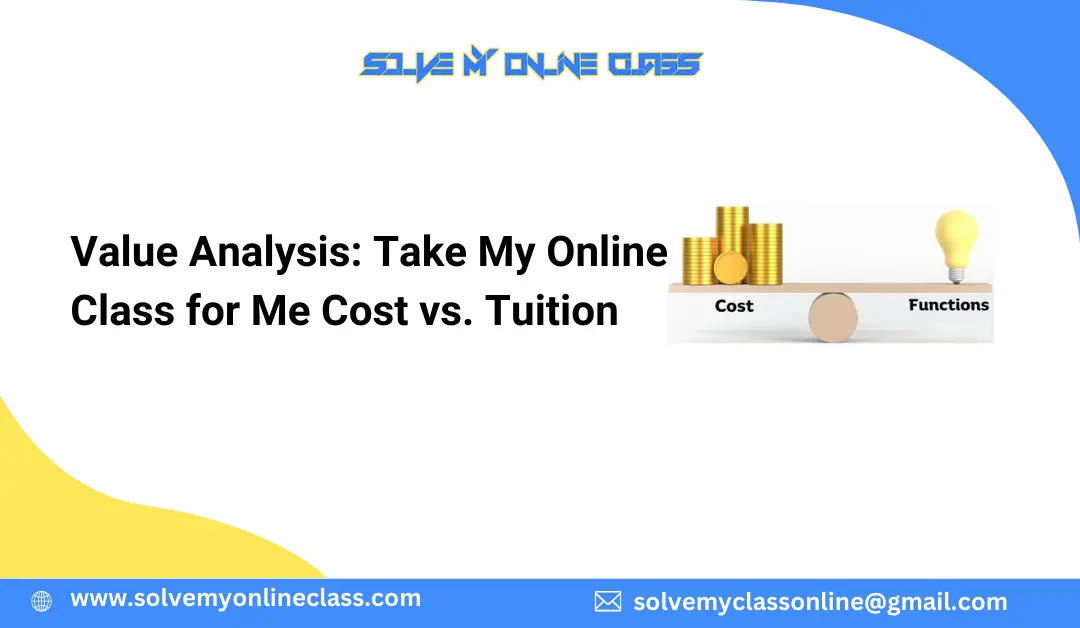
Over a 15-week semester, that’s 180 hours per course. If a student is a working professional earning $35/hour, those 180 hours represent $6,300 in potential pre-tax earnings. When you add the $4,000 tuition to the $6,300 in lost time, a single “filler” course actually costs the student over $10,000.
When a student decides to hire someone to do my online class, they are effectively buying back those 180 hours. Even if the service costs $800, they are “trading” $800 to reclaim $6,300 worth of time. That is a net positive value of $5,500.
3. The Cost of Failure: Risk Mitigation
In any financial model, risk must be accounted for. In academia, the greatest risk is failure or withdrawal. If a student fails a course due to burnout or lack of time, the tuition money is gone, it is a “sunk cost.” To get the credit, they must pay for the course a second time.
| Scenario | Total Tuition Spent | Grade | Outcome |
| Self-Managed (Burned Out) | $4,000 | F/D | Must Retake (+$4,000) |
| Self-Managed (Stressed) | $4,000 | C | GPA Damage |
| Assisted Management | $4,000 + $800 Service | A | 4.0 GPA / Time Saved |
By utilizing online class help, the student is essentially purchasing an insurance policy on their $4,000 tuition. The professional service ensures that the capital investment results in a high-grade asset (the A or B) rather than a liability (a failing grade).
4. Quality of Instruction vs. Quality of Assistance
A common critique is that students should “do the work to learn.” However, the reality of many online modules is that they are automated, “templated” courses with little to no actual instruction from the professor. In these cases, the student is essentially teaching themselves from a PowerPoint deck.
When you pay for academic assistance, you are often being paired with a subject matter expert, someone with a Master’s or PhD who understands the material better than the automated grading system. This creates a high-efficiency workflow. The professional manages the “mechanics” of the course (deadlines, formatting, submission portals), while the student can focus on high-level concepts that actually benefit their career.
5. Mental Health: The Intangible ROI
We cannot discuss value without discussing the psychological toll of the modern “hustle culture.” The stress of balancing a full-time job, a family, and a 15-credit-hour semester leads to academic fatigue. This fatigue has real-world costs:
- Decreased productivity at work.
- Strain on personal relationships.
- Health issues related to sleep deprivation.
If taking my online class for me reduces cortisol levels and allows for eight hours of sleep instead of five, the value of that service is immeasurable. A rested professional is a more effective professional, likely leading to promotions and raises that far outweigh the cost of an academic service.
Conclusion: A Strategic Reallocation of Resources
A professional value analysis shows that “online class help” is not an expense it is a strategic reallocation of resources. By spending a small fraction of the tuition cost to secure the grade and reclaim hundreds of hours of time, the student is maximizing the ROI of their degree. They are choosing to work on their degree rather than being a slave to it.